The session, Math Continuum: Multiplication and Division - Session 3, was presented online on Thursday, November 14th. This online session was presented by Heather Wark (Lakehead University), Denise Ladd, and Tien Ngo (LKDSB Instructional Coaches).
Children should learn their number facts. However, they would benefit from learning these facts by using an increasingly sophisticated series of strategies rather than by jumping directly to memorization. - (Lawson, 2016, p. 4)
Strategies help students find an answer even if they forget what was memorized. Discussing math fact strategies focuses attention on number sense, operations, patterns, properties, and other critical number concepts. - (O’Connell & SanGiovanni, 2011, p. 5)
Strategies Include: - Array Model - Decomposing a Factor - Starting from a known fact - Distributive Property Join us for the next sessions that will dig into the strategies:
The session, Math Continuum: Multiplication and Division - Session 2, was presented online on Thursday, November 7th. This online session was presented by Heather Wark (Lakehead University), Samantha VanHooft, and Alicia Schenck (LKDSB Instructional Coaches).
Children should learn their number facts. However, they would benefit from learning these facts by using an increasingly sophisticated series of strategies rather than by jumping directly to memorization. - (Lawson, 2016, p. 4)
Strategies help students find an answer even if they forget what was memorized. Discussing math fact strategies focuses attention on number sense, operations, patterns, properties, and other critical number concepts. - (O’Connell & SanGiovanni, 2011, p. 5)
Strategies Include: - Partitive and Quotitive Division Join us for the next sessions that will dig into the strategies:
The session, Math Continuum: Multiplication and Division - Session 1, was presented online on Thursday, Oct 24h. This online session was presented by Heather Wark (Lakehead University), Tien Ngo, and Denise Ladd(LKDSB Instructional Coaches).
Children should learn their number facts. However, they would benefit from learning these facts by using an increasingly sophisticated series of strategies rather than by jumping directly to memorization. - (Lawson, 2016, p. 4)
Strategies help students find an answer even if they forget what was memorized. Discussing math fact strategies focuses attention on number sense, operations, patterns, properties, and other critical number concepts. - (O’Connell & SanGiovanni, 2011, p. 5)
Strategies included:
Unitizing
Modelling composite units and counting by 1
Counting Rhythmically
Skip Counting
Using Repeated Addition
Join us for the next sessions that will dig into the strategies:
The session, Why We Use Lawson's Math Developmental Continua: An Overview, was presented online on Thursday, Oct 17th. This online session was presented by Heather Wark (Lakehead University), Sally Parkinson, and Kate Allison (LKDSB Instructional Coaches).
Children should learn their number facts. However, they would benefit from
learning these facts by using an increasingly sophisticated series of strategies
rather than by jumping directly to memorization.
- (Lawson, 2016, p. 4)
Strategies help students find an answer even if they forget what was
memorized. Discussing math fact strategies focuses attention on number
sense, operations, patterns, properties, and other critical number concepts.
- (O’Connell & SanGiovanni, 2011, p. 5)
Join us for the next sessions that will dig into the strategies:
Math Strategy: Decomposing a Factor: Multiplication
Math Strand: Number sense and numeration
Location on the Continuum:
Overview:
“Decomposing a Factor” can be described as a multiplication strategy with legs.
This strategy builds on the student’s understanding of number and leverages that knowledge to be able to work with numbers with increased flexibility and efficiency.
We often observe students using Repeated Addition or Skip Counting strategies to solve multiplication problems with smaller numbers or friendly numbers. These strategies support Additive Thinking.
3 x 7
7 + 7 + 7
=21
25 x 6
25, 50,75,100,125,150
When students engage with multiplication problems with larger numbers and use these strategies, we often notice that accuracy and efficiency is negatively impacted.
When a student becomes comfortable with a strategy, it is time to challenge their thinking.
Moving from Additive Thinking to Multiplicative Thinking.
We are looking for ways to move students when they may be stuck/overly reliant on these strategies. Our challenge is to help shift students from additive thinking into multiplicative thinking. Introducing and developing the “Decomposing the Factor” will help students to make the shift.
Additive Thinking
Multiplicative Thinking
Addition - action of joining or putting things together
Multiplication - many to one relationship (or one to many)
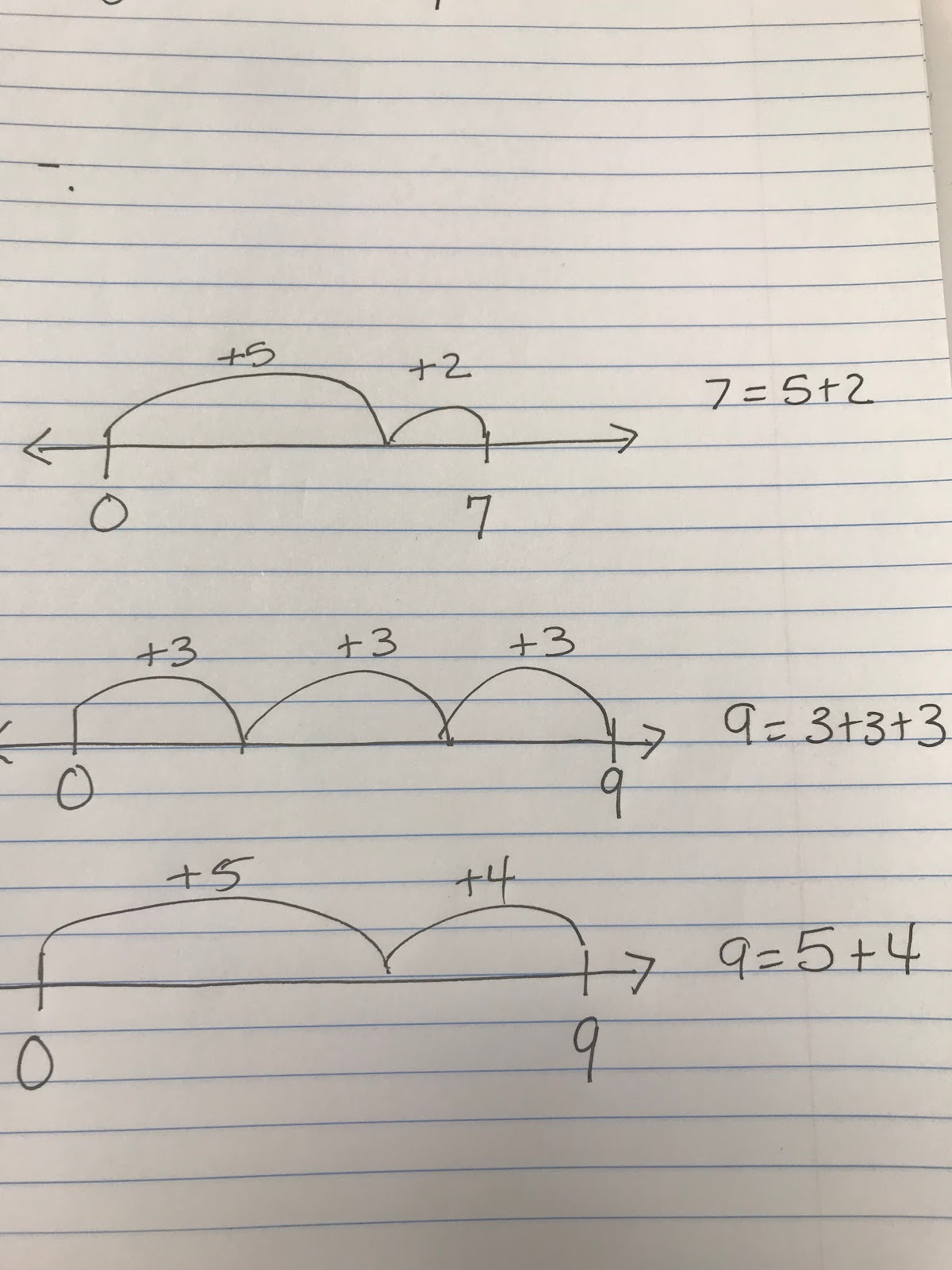
Decomposing a Factor (number) means to break apart the number to uncover the numbers within the factor.
7 = 5 + 2
7 = 3 + 3 +1
9 = 5 + 4
9 = 3 + 3 + 3
Supporting Students: Representing on Number Lines
A student may decompose connecting to known facts (doubles).
14 = 7+7
22 = 11 + 11
44 = 22 + 22
When working with larger numbers, students may decompose the number by place value.This a specific type of decomposing along place value lines is called SPLITTING.
14 = 10 + 4
44 = 40 + 4
125 = 100 + 20 +5
Supporting Students: Representing with Base Ten, Place Value Chart
When students use the Decomposing a Factor strategy to solve multiplication problems, how they choose to decompose the number will reflect how they plan to work with the numbers. The goal is for students to be increasingly flexible, strategic, and efficient as they solve basic fact problems.
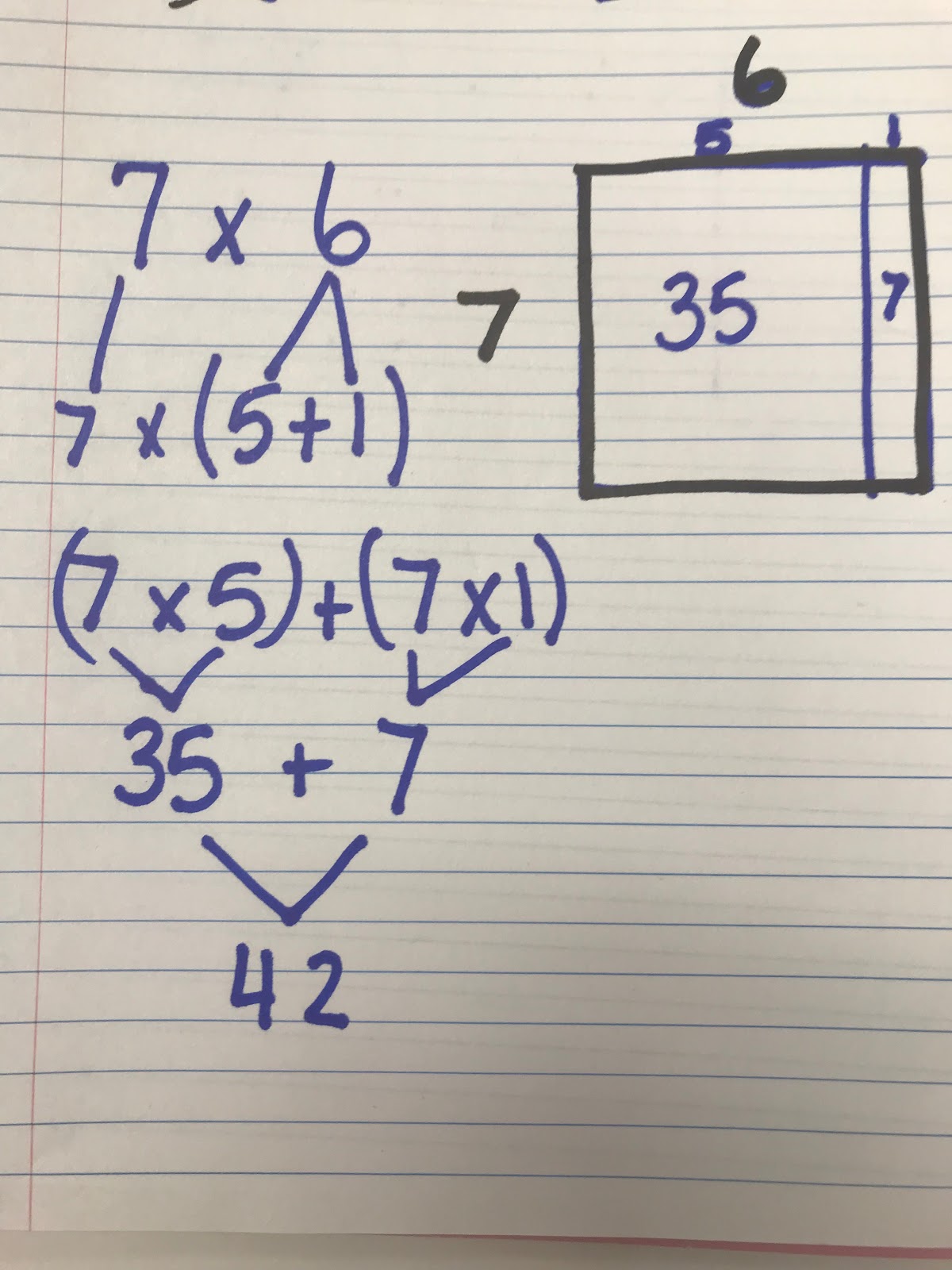
Using this strategy also hinges on accurately applying the distributive property when multiplying.
Students need to trust
That 7 decomposes into a 5 & 2,
They can work with 5 and 2 separately and then add them back together to get to the solution.
Ontario Math Curriculum Glossary
Distributive Property.
The property that allows a number in a multiplication expression to be decomposed into two or more numbers;
for example, 51 x 12 = 51 x 10 + 51 x 2.
More formally, the distributive property holds that, for three numbers, a, b, and c,
a x (b + c) = (a x b) + (a x c)
and a x (b – c) = (a x b) - (a x c);
for example,
2 x (4 + 1) = 2 x 4 + 2 x 1
2 x (4 – 1) = 2 x 4 – 2 x 1.
Multiplication is said to be distributed over addition and subtraction
Examples
Develop Decomposing Skills:
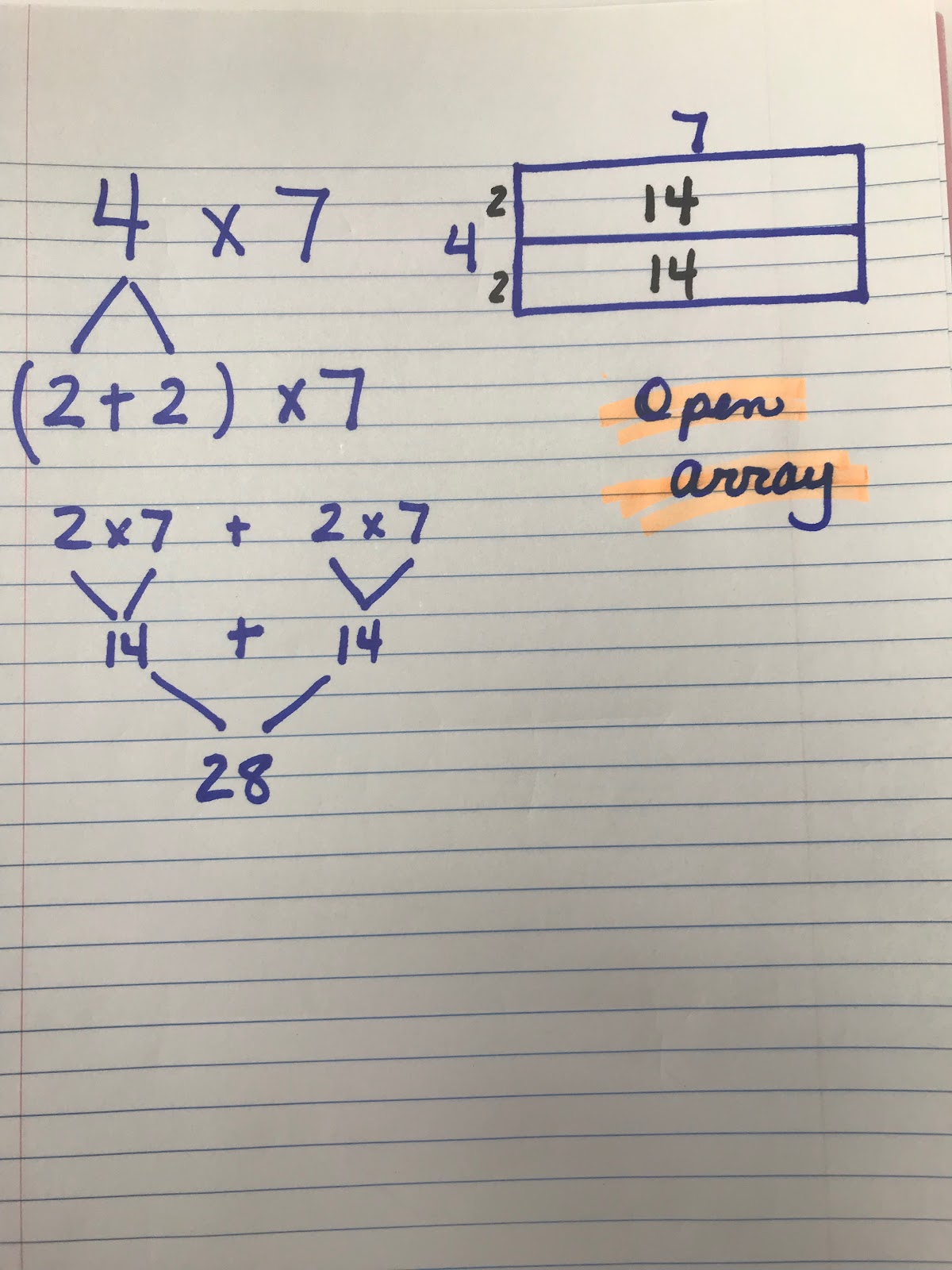
Arrays: The array model is a tool that helps students represent their math thinking.
Concretely building arrays with manipulatives, pictorially representing closed arrays on grid paper, or drawing open arrays helps students to visualize and verify the decomposed factor and how it can be used to determine the product (answer) The Key Idea of Part Part Whole is developing.
.Encourage students to “Break apart” the array using the decomposed numbers.
“The numbers within the factor”
Where to Next?
Strengthen student skills by working with intentional sequences of numbers (a.k.a. strings of numbers).
Number Talks/Strings/Sequences
Challenge students to explain what numbers they find within a factor. Students can leverage their “Friendly number” knowledge.
The Decomposing a Factor strategy is a strategy that helps students access other strategies on the continuum. (Using 10X, Using Familiar Facts,)
When students flexibly and efficiently Decompose Factors, they will have the knowledge and skills to develop and access the Using Partial Products strategy.
Resources: Here are the links to the different folders for the games shared during the video that support students with Getting to a Decade Number and making jumps of 10 forward and backwards.
Math Strand: Number Sense and Numeration Math Strategy: Skip Counting
English video:
Video french:
Materials: One die, whiteboard and whiteboard marker
(Extension: colour tiles)
Overview:
This game is very engaging for students and helps to prepare students to move from using repeated addition to using grouping of numbers when modeling arrays when solving multiplication problems. After completing this lesson you would then begin a lesson using arrays for equal groups.
On each turn, students roll a 1–6 number cube to find out how many circles to draw and then roll the cube again to find out how many stars to draw in each circle. For example, for a first roll of 4 and a second roll of 3, the student would draw this:
How this activity supports student learning?
Playing Circles and Stars helps students understand that multiplication
can be thought of as combining equal groups and is, therefore, related to addition when the same number is added multiple times. From playing, students become familiar with multiplying numbers from 1X1 to 6X6.
As an extension, you could use try using an 8 sided die.
After students know how to play the game, they learn to represent each
of their turns with addition and multiplication equations. This helps them connect the standard symbols to their experience and also strengthens the connection between addition and multiplication.
Where to next?
In the Alex Lawson text, What To Look For there are several other games that can be played to support unitizing, such as: - How Long? How Many?, which uses Cuisenaire rods - Skip Counting Race - Target 75 - Multiplication Challenge
These can all be found on page 185-189.
Share your classroom experiences with us on Instagram and Twitter at @LKelempro #EngageLK!
Strand: Number Sense Numeration multiplication
Math Strategy: Using Familiar Facts
Materials: variety of Arrays cards, corresponding multiplication fact cards
Overview:
During this activity, each student has a different card. Each card shows a different array on one side and the corresponding multiplication fact on the back. Student will ‘mill about the room’ finding another student to Quiz, by showing them their array picture and having the opponent say the multiplication fact on the back. Then the other student will Quiz (show) his/her array and have their opponent say the multiplication fact. Before finding another opponent, the two students trade their cards and move on. The activity ends when students have had a chance to subitizing a few different arrays and time is up.
How this supports students learning:
This activity supports students developing a conceptual understanding of math facts by giving them the opportunity to represent multiplication facts pictorially. Using models, students can use various objects and materials that will help them make sense of operations such as array formations.
“Arrays are powerful models for representing multiplication, division, and area. Many objects in real life can be arranged in arrays, and such arrays provide visual, concrete contexts for multiplication and division. The construction and understanding of an array as a model is an important concept for students to develop over time and with experience.” (GEIM., vol.5 pg. 35)
Where to next: once students have mastered arrays, they will be able to break multi-digit factors into smaller parts for easier solutions such as; 14 x 9 = 4 x 9 + 10 x 9. The student can further their understanding of breaking arrays into smaller factors by using base ten blocks to represent larger numbers and breaking them into smaller factors.
Math Strand: Number Sense and Numeration - Multiplication Math Strategy: Repeated Addition
English:
French:
Materials:
Cuisenaire rods, one die, How Long? How Many? Recording Sheets ( MK12, one for each player) and pencil
Overview:
This activity can be found in the Alex Lawson’s “What To Look For” book on page 186.
The goal is to cover as many squares as possible on the recording sheet. Students will roll a die twice, the first roll tells the length of the Cuisenaire rod and the second roll tells how many of these rods are to be used. The player places the rods on his or her recording sheet to form a rectangle and traces around the outside. The game encourages modelling of groups by representing the array and writing the total number of squares that the rectangle covers. For example, four 3-rods would cover 4 x 3 = 12 squares. The multiplication equation is written inside the array. This allows students to double check their answers and helps reinforce multiplication facts by connecting them to a visual representation.
How this activity supports student learning?
How Long? How Many? helps students develop early multiplication facts. This game supports students understanding of unitizing, which is the idea that objects can be simultaneously viewed as individual objects and as a composite units that can be counted. Throughout the game, students use direct modelling to solve the problems, such as modeling 3 rows of 4, then counting each square. Moving beyond counting by ones, children may begin to rhythmically count the rows or they may repeatedly count groups on their fingers. This will then lead to more efficient strategies such as skip counting or repeated addition.
Where to next?
Adaptation: Depending on the needs of your students, new recording sheets can be created by adding or removing rows or columns of squares.
In the Alex Lawson text, What To Look For there are several other games that can be played to support unitizing on page 185 - 189, such as: • Circles and Stars • Skip-Counting Race • Target 75 • Multiplication Change
Share your classroom experiences with us on Instagram and Twitter at @LKelempro #EngageLK!
Math Game: Multiplication Tic-Tac-Toe (Le Morpion de Multiplication) Math Strategy: Using Familiar Facts Math Strand: Number Sense & Numeration: Multiplication
English:
French:
Overview: The goal of this activity is for students to recognize factors of products in front of them so they can begin to identify them more quickly. However, we cannot ignore the importance of providing students the opportunity to use models to help develop meaning for the symbols in operations and to lessen their abstraction. Therefore, before introducing this type of activity, students should have had many previous opportunities to use various objects and materials to help them make sense of multiplication.
How this activity supports learning: Playing games, like “Tic Tac Toe Multiplication” (Le Morpion de Multiplication), is a great way to support the automatic recall of multiplication facts.
By using a game to reinforce the concept, students will be engaged and this will provide the teacher the opportunity to circulate and have a quick look into where students are having success and what challenges they may be encountering. It also helps us to discover what strategies our students are using and where they are on the continuum of learning. Once we can identify what strategies our students are using, we can help determine a more efficient strategy to help improve that individual's proficiency with multiplication.
Where to next? Remember to include variations of the game to challenge students appropriately and maintain engagement. This will also provide students the opportunity to develop a strong proficiency with a variety of factors and products. As you circulate, join different students games and don’t forget to ask them to explain how they knew their answer. Having students explain their thinking, not only gives us insight into the strategies they used, but also provides a model for others as to different ways to think about the same problem. The more students share ideas and thinking, the more their learning can progress.
Strand: Number Sense and Numeration Strategy: Skip Counting
Materials: One 6-sided die with the numbers 2, 2, 3, 3, 4 and 5 (use stickers over the existing numbers) BLM MK13: Skip Counting Race game board
Overview: The students (or teacher) determines the number that the students will skip count by, prior to beginning the game. Students roll the die and skip count by the agreed upon number, based on the number rolled. For example; if a student is skip counting by 2 and rolls a 3 they must skip count 3 times (2, 4, 6). The first student to reach 60 wins.
How This Supports Students Learning: This game provides students with the opportunity to develop efficiency by using the skip counting strategy. Students that are able to skip counting can use this strategy when solving multiplication problems. They are also strengthening their understanding of unitizing; recognizing that each time they skip count the value represents a given quantity or set of numbers.
In this game, students begin by skip counting with a friendly number once they master this skill they can move on to another number. Teachers may want students to begin with 5 or 2, moving forward to 3 or ’s.
For students that are struggling with skip counting, they may rely on counting rhythmically by 1’s, emphasizing every time they have added a unit (1, 2, 3, 4). It may also be helpful to provide the student with an extra copy of the game board and have them use two different colours to record their counting (colour 2 squares red, two squares blue, etc.).
Where To Next: Once students have developed efficiency with the skip counting strategy, they are able to move towards using repeated addition and doubling strategies. As students are introduced to the repeated addition strategy it may be useful for them to first skip count and then to record their addition sentence above this, in order to make the connection between the two strategies visible.
Additional games to reinforce the concept of skip counting from the What to Look For text by Alex Lawson include Target 75 (page 188) and Array Pattern Flashes (page 194).
Strand: Number Sense and Numeration, Addition & Multiplication Math Strategy: Using Familiar Facts
Materials: • Triplets deck addition (BLM16 and BLM17) • Triplets deck multiplication (BLM19 and BLM20) (These are located in the Guides to Effective Instruction, Vol. 5) Overview:
Using the addition or multiplication cards provided in the GEIM Volume 5, students can play independently, in groups, or with the whole class. Students will have to match their answer card with the matching fact cards for each set. An example of a triplet would be the three cards: 3+5, 5+3, and 8; or 3 x 6, 6 x 3, and 18. In addition to sorting and matching the cards, you can also play a variation called « Go Fish », where students need 3 cards to make the set.
How this Supports Student Learning:
This game provides students an opportunity to strengthen their understanding of « commutative » property, which stems from the idea of moving stuff around. Addition and multiplication have the property of commutativity. When numbers are added or multiplied, the operation can occur with the values in any order and the same answer will be obtained: 3 + 2 = 5, 2 + 3 = 5; 4 x 6 = 24, 6 x 4 = 24. Subtraction and division are not commutative. Where to next?
Some students immediately see the connection between the commutative property of addition and multiplication. For others, this is something that has to be seen, felt and experienced many times before they believe it. That's okay! This activity provides an opportunity for the learners who need to see the connections to have that time. This property allows students to work with numbers flexibly, as they adjust numbers to make them easier to work with. One option to support students in grasping this concept would be to build arrays for multiplication and represent amounts with manipulatives when adding. Placing the values in the part-whole model would also support students to grasp this property.
Addition: Ten Frame activities in the Guide to Effective Instruction: Number Sense and Numeration K-3 support this thinking (i.e., Ten in the Nest, Ten Frame Cards, etc).
Multiplication: The game Boxed Out could support this thinking.
Game: Boxed Out
Math Strand: Number Sense and Numeration
Math Strategy: Using Familiar Facts
English Video:
French Video:
Purpose:
To create grid arrays for basic multiplication facts.
Task Instruction
· This game is played in partners. Two children share a blank grid.
· The first partner rolls two number dice.
· The numbers that come up are the numbers the child uses to make an array on the grid.
· They can put the array anywhere on the grid, but the goal is to fill up the grid to get it as full as possible.
· After the player draws the array on the grid, she writes in the number sentence that describes the grid. Students record the multiplication fact in two places: once on their side of the calculation board and the other time inside the rectangular array. By writing and recording we hope that this repetition will enhance their memory of these facts to reach the eventual goal of automatic recall.
· The second player then rolls the dice, draws the number grid and records their number sentence.
· As more and more arrays occupy the game board fewer arrangements are possible. When a student cannot create an array they may roll up to three times in a row hoping to roll a multiplication fact that will fit. When they are BOXED OUT the game is finished.
Alternative Goals: Students could try collectively to occupy as much of the game board as possible.
Learning Multiplication Facts:
A knowledge of basic multiplication facts supports students in understanding multiplication concepts, and in carrying out more complex computations with multi-digit multiplication. Students who do not have quick recall of facts often get bogged down and become frustrated when solving a problem. It is important to note that recall of multiplication facts does not necessarily indicate an understanding of multiplication concepts. For example, a student may have memorized the fact 5 × 6 = 30 but cannot create their own multiplication problem requiring the multiplication of five times six.
The use of models and thinking strategies helps students to develop knowledge of basic facts in a meaningful way.
Where to Next?
Creating arrays of larger numbers to model partial products.
Consider the following problem.
“Amy’s uncle has a large stamp collection. Her uncle displayed all his stamps from Australia on a large sheet of paper. Amy noticed that there were 8 rows of stamps with 12 stamps in each row. How many Australian stamps are there?”
To solve this problem, students might arrange square tiles in an array, and use various strategies to determine the number of tiles. For example, they might count the tiles individually, skip count groups of tiles, add 8 twelve times, or add 12 eight times. Students might also observe that the array can be split into two parts: an 8 × 10 part and an 8 × 2 part. In doing so, they decompose 8 × 12 into two multiplication expressions that are easier to solve, and then add the partial products to determine the product for
8 × 12
8 × 10 = 80
8 × 2 = 16
80+16 = 96
Printing these game boards out on 11 X 17 card-stock and then laminating them is helpful to provide many opportunities for students to reinforcing these facts. Playing this game at home will also provide an enjoyable way for parents and guardians to support their children.
Game: Concentrating on Doubles
Strand: Number Sense and Numeration, Addition and beginning Multiplication
Math strategy: Doubling
Materials:
Concentrating on Doubles cards ( BLM8 GEIM vol 5) 1 or 2 sets for each pair
Overview:
Students can play in pairs or small groups. Similar to 'memory' or other concentration games, students place all of the cards face down and spread out on a desk or floor. Each player takes a turn, by turning up two cards at a time. The goal of the game is to match the doubles number expression with the correct sum card. If a match is found, the player keeps the cards. If a match is not found, then the cards are turned over in the same place, and it is the next player's turn. The player with the most matches wins.
*a variation on this would be to have students play individually with a timer to see how many matches he/she can find in a set amount of time.
How this supports Student Learning:
This game provides opportunities for students to strengthen their doubles facts. Students are often able to learn certain number facts, such as doubles (e.g., 3+3 , 5+5) before others, and will use these known facts to derive answers for unknown facts (3+4 is related to 3+3 and 5+6 is related to 5+5).
There are only ten double facts. Students can practice learning facts by playing games such as concentrating on doubles, which will lead them to the learn the two times tables. The two times tables should be linked to student's prior knowledge about the addition of doubles.
Where to next?:
This strategy is particularly helpful because students who know their two times table well can relate these facts to the three times table. If 2 x 4 is 8, then 3 x 4 is 8 plus one more group of 4.
They will see connections to everyday items when they think about doubles:
When students know the double facts (two times tables), they can apply this knowledge to the four times table by simply doubling the product.
Another way to help students learn doubles is by models. This helps students make connections between the models, the symbols, and the words. The emphasis is on understanding the concept and accessing the strategies for computations with multiplication.
Games to support where to next:
Over-Easy Doubles GEIM Vol.5, pg. 73 (BLM10)
Snappy Doubles GEIM Vol.5, pg. 75 (BLM12)
Find a Friendly Neighbour GEIM Vol. 5, pg 75 (BLM13)
Spinning for Near-doubles GEIM Vol.5 pg 76 (BLM14)