Showing posts with label splitting. Show all posts

Wednesday, January 8, 2020

What's The Math Strategy?


What’s The Strategy?
We hope you enjoy this video that was created to be shared with your class.  The video is 4 minutes long. However, it is intended to create a 10-15 minute discussion with your class (including video time). If you watch the video first, it will give you an idea of the best discussion points for your students.  


Suggestions for Pausing:
You might want to pause at the very beginning, 0:14 seconds, to allow your students to use mental math to solve the question.  Or, perhaps your students are not ready for mental math at this level. If that is the case they could be allowed manipulatives or whiteboards to solve.  When students are allowed to take time to solve the problem they will engage more with the rest of the video as they too will have entered into the problem.


From :23 seconds to :42 seconds, Eamon shares how he solves the problem.  You might want to replay this section a few times to allow students to figure out how he is solving the problem.  


From :43 to :48 seconds students are prompted to consider how he solved the problem.  At this point, students could turn and talk to describe what they think Eamon did to solve the problem.   After they decide how he solved it, ask a student to share their idea of how it was solved.  


Watch another student explain Eamon’s thinking on the video from :50 - 1:23.  Was your students’ explanation similar to Myla’s?  


The next section of the video describes ways to represent Eamon’s thinking.  Depending on your students’ understanding of the strategy, you may decide to focus on one representation more than another.  
1:27 - 2:25 seconds - Eamon’s thinking is represented with ten frames.
2:25 - 3:15 seconds - Eamon’s thinking is represented on a number line.
3:16 - 3:28 seconds - Eamon’s thinking is represented in numeric form, but in a friendly manner that is accessible to more students. 
3:28 - 3:47 seconds - Eamon’s thinking is represented in accurate numeric representation.  


Eamon’s strategy is then named at 3:50 seconds.


In the end, students are asked if they could use one of Eamon’s strategies.  
Here is a link to cards that summarize the strategies, if you’d like to use them to support a discussion of the strategies in your class: Addition/Subtraction Strategy Cards 


If you have a video of a student solving a strategy that you think could be made into a ‘What is the Strategy?’ video, please share it with the coach connected to your school.  


Questions You Might Ask Students:
  1. Did you visualize his strategy in a different way?
  2. Is there another way to solve this question?
  3. Do you think there is a more efficient strategy? Why?
  4. With what numbers would you want to use Eamon’s strategy? What numbers wouldn’t you want to use Eamon’s strategy with?


Key Thinking To Support Student Thinking:
In this example, Eamon is using place value to solve the problem.  When Eamon thinks along place value lines, it allows him to solve double-digit numbers in a simplified manner.  Solving along place value lines is the precursor to making sense of the standard algorithm. If your students are ready, perhaps they can be asked to make the connection between the splitting strategy and an alternative algorithm:
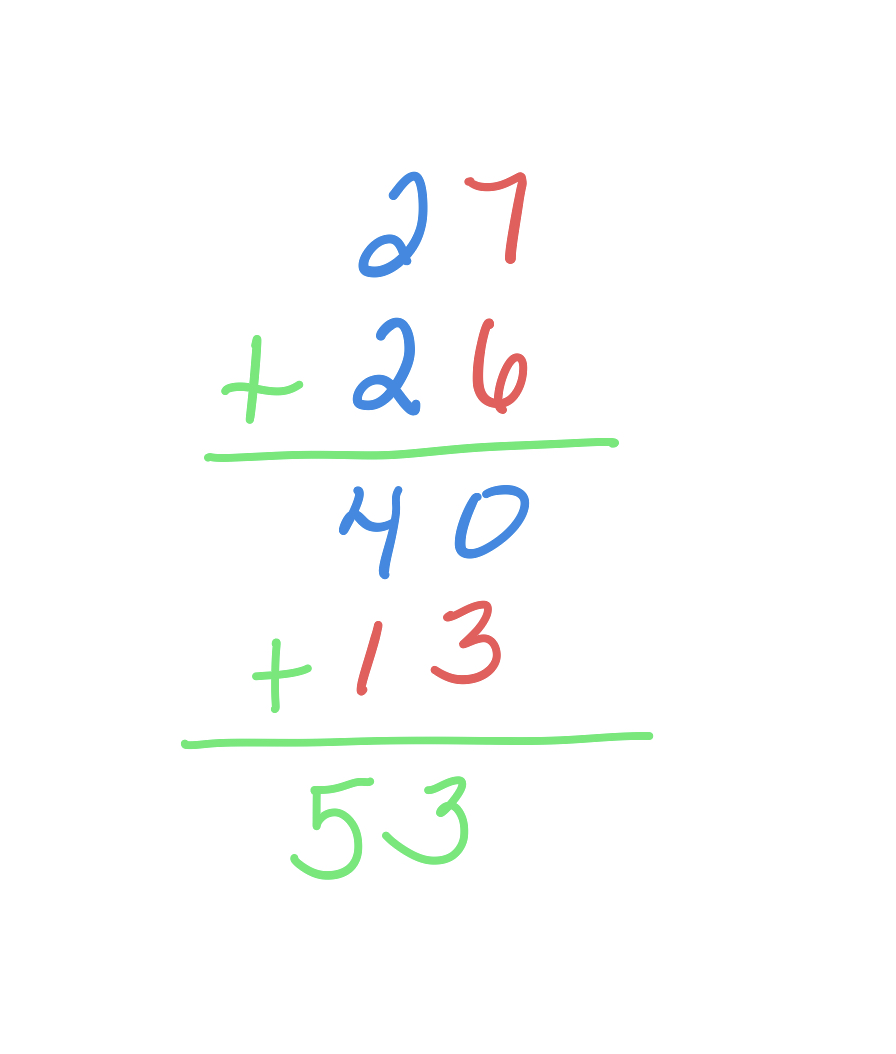

With adding, we can break apart numbers and reorganize numbers in ways that make adding easier.  When students demonstrate various ways to decompose a number or reorganize numbers it is important to draw students’ attention to this.  This will support students to become flexible with numbers. They will realize they can move numbers around in a way that works to make it easier for them.  


When students see different representations of any operation, it is useful to help students make the connection between the different representations.  It is the idea of concrete fading, we represent thinking concretely then support students to transition to a numeric representation. This will allow students to have a visual mental representation to connect to the numbers.   It will strengthen their understanding of what is happening and allow them to move towards only representing operations numerically. When understanding a new strategy, it helps students to make sense of it concretely first.  


Strategies From The Continuum: 
Getting to a Decade Number
Splitting


Tuesday, November 19, 2019

Math Continuum: Addition and Subtraction - Session 3


The session, Math Continuum: Addition and Subtraction - Session 3, was presented online on Tuesday, November 19th.  This online session was presented by Heather Wark (Lakehead University), Alicia Schenck and Samantha Vanhooft (LKDSB).  

The continua referenced are:
- Addition and Subtraction Continuum by Dr. Alex Lawson, Lakehead University

Children should learn their number facts. However, they would benefit from learning these facts by using an increasingly sophisticated series of strategies rather than by jumping directly to memorization.
- (Lawson, 2016, p. 4)

Strategies help students find an answer even if they forget what was memorized. Discussing math fact strategies focuses attention on number sense, operations, patterns, properties, and other critical number concepts.
- (O’Connell & SanGiovanni, 2011, p. 5)


Strategies include:
- Splitting
- Getting to a decade # 
- Taking jumps of 10 forward/backward

- Using overshoot & return


Thursday, January 17, 2019

Math Activity to Teach Using Known Facts / Familiar Facts: Salute

Math Activity: Salute

Strand: Number Sense and Numeration, Addition & Multiplication
Math Strategy: using known facts; using familiar facts

English:


French:


Materials: 
• 1 deck of cards with 10, J, Q and K removed
• A math tool to help solve the problem (rekenrek, counters or square tiles)
• 3 players

Overview: 
In this game students work to find the “missing part” or value of the card on their head. Students take turns being the “sum finder”, adding up the value of the two cards and shouting out the sum. Each student needs to use the part they see (the value of the card on the other players forehead) and the whole to determine the value of the card on their forehead. After each turn the players rotate their roles by one so that each player has a chance to be the sum finder or to find the missing part.
How this Supports Student Learning:
Students are able to practice a variety of math strategies through this game. Students can find the missing part by counting on, making ten, using doubles or familiar facts. In this game, each player could be practising a different strategy. Having a math tool nearby will support students in solving the problem.

Where to next?
For students that are developing their ability to join numbers, removing all cards greater than 5 may be helpful. As students become comfortable finding the missing part you can increase the complexity of the game by adding higher value cards, eventually including 10 - K, and assigning a value to each card. Alternately you can refer to each card as a decimal tenths. For example if player 1 draws a 7 and player 2 draws a 4 the sum finder would call out “1 and 1 tenth”. In order for the “part finders” to win the round they must refer to their card as a tenth (I.e.7/10 or 2/10 in this case).

Tuesday, October 16, 2018

Math Strategy: Splitting

What does the math strategy Splitting mean?

Math Strategy: Splitting
Math strand: Number Sense and Numeration


Overview:
Splitting is a strategy where numbers in an equation are broken apart into their place value to make calculations easier. This involves, for example, combining 25 objects and 37 objects by breaking apart both numbers into their tens and ones, combining the tens, combining the ones, and finally combining the total of the tens with the totals of the ones.


The splitting strategy for subtraction can difficult for some and may be written in different ways.

In this example, the student splits both numbers into place value, subtracts 30 from 60, adds on 2, then subtracts the final 7


In the second example, the student splits the number being subtracted into place value, subtracts 30, then subtracts the final 7


How this supports student learning:
Students that use this strategy are developing many of the key ideas in mathematics, such as place value, part-whole relationships and commutative property. They understand that the position of a digit determines its value. As well as knowing that breaking up the numbers and moving them around still results in the same sum. Experience with making models of two-digit numbers using base ten blocks supports students use of this strategy. When students can combine their computational strategies with an understanding of base ten grouping, they develop very efficient ways of using their understanding to mentally calculate operations.

Where to next?
Splitting mini-lessons such as Splitting Sequences can be found in the Teacher’s Math Kit, specifically on page 202 in the text “What to Look For” by Alex Lawson.

Share your classroom experiences with Splitting with us on Instagram and Twitter at @LKelempro #EngageLK!

Tuesday, October 2, 2018

Math Activity: Trading Up to 1000 (Skip Counting, Splitting, Taking Jumps)

Trading Up to 1000


Math Strategy:
This game supports the development of skills required for skip counting, splitting, and taking jumps (see Lawson continuum). Also, it helps students to represent, compare, and order whole numbers to 1000.
Math Strand: Number Sense and Numeration


Overview: 
Start with two teams and alternate turns between teams. In this game, students start with a 2 digit number and build their amount in base ten blocks on their place value chart. Then they roll one die to see how many times they can skip count on by ones, tens, and thousands. They decide each time which value they will skip count by. The goal is to be the first team to create a cube (of 1000). This game can be played with only 2 players once students know the game.


This game will allow you to see if your students are still at the concrete stage of skip counting on. If they move away from building with the base ten blocks on the place value chart then you know they have grasped (or are beginning to grasp) how to count on without the use of a model to assist them. If they are relying on the base ten then you know more practice, with this game, would be beneficial to them.


How this supports student learning:
Being able to start counting at any number is important because it shows how well a student understands numerical order. Students will have practice skip counting concretely and numerically at the same time. Thus connecting the two representations. It also helps students to learn that you can use friendly numbers to skip count on from any number. This will prepare your students for situations when they are learning to use strategy taking jumps. See the example below taken from Lawson's What To Look For on page 86.


The game will increase students' familiarity with breaking numbers apart into their place value. This will prepare them for using the addition & subtraction strategy of splitting:


(What To Look For, pg 86)

This game can be changed to meet your students' needs by changing the trading up to a different amount (10 000 or 100). If increasing the amount to 10 000 give the students the additional option of skip counting on by 1000.


Where to next?
This activity can be found in the Guide to Effective Instruction in Mathematics, Number Sense and Numeration, on page 143. To allow students to apply the skills they have learned in this game, begin looking at addition and subtraction activities that support skip counting, splitting, and taking jumps in "What to Look For" by Alex Lawson.

Share your classroom experiences with Trading Up To 1000 with us on Instagram and Twitter at @LKelempro #EngageLK!